TB-500 dosage and half-life
An amount without its molecule, route and subjects is an incomplete experimental record. These are study quantities, with no human dosing recommendation.
Intravenous safety study
The randomized, placebo-controlled Phase 1 study enrolled 40 healthy volunteers and tested full-length synthetic thymosin beta-4 intravenously at 42, 140, 420 and 1260 mg. Participants received a single administration followed by daily administration for 14 days. The study reported infrequent mild or moderate adverse events, no dose-limiting toxicities and no serious adverse events.
The bounds of that observation matter to me: healthy adults, an intravenous preparation of the full protein and a short period of observation. It establishes neither a human dose for TB-500 nor a long-term safety profile for the fragment.
Rat neurological outcomes
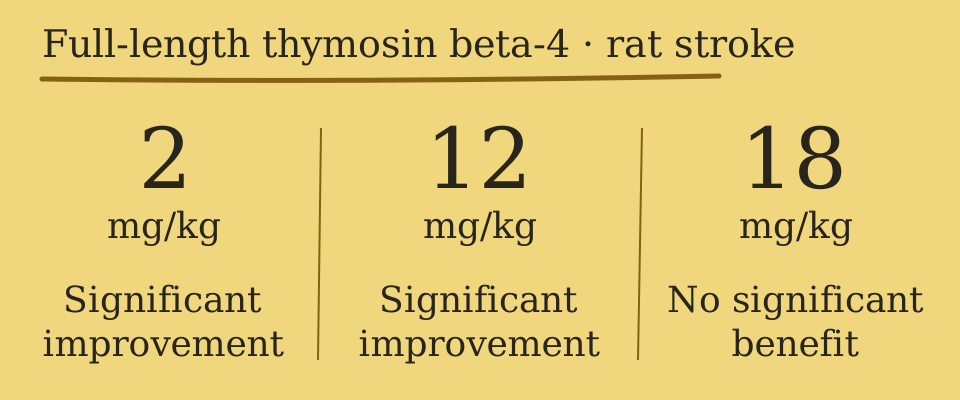
In Morris and colleagues’ embolic-stroke experiment, male Wistar rats received intraperitoneal full-length thymosin beta-4 at 2, 12 or 18 mg/kg, beginning 24 hours after stroke and followed by four more administrations three days apart. The 2 and 12 mg/kg groups showed significant neurological improvement from day 14 through day 56; the 18 mg/kg group showed no significant benefit.
The authors proposed an optimal modeled amount of about 3.75 mg/kg. That exact amount was a model estimate, not a tested group. I see the missing benefit at the highest amount as a serious objection to the assumption that increasing exposure must improve recovery. These rat regimens cannot set a human schedule.
TB-500 half-life
There is no validated human pharmacokinetic half-life for the TB-500 heptapeptide. Half-life describes the time for an amount in the body to fall by half. In the intravenous full-length thymosin beta-4 study, half-life increased with dose and pharmacokinetics were dose-proportional.
That finding gives the larger protein a measured context. It leaves the fragment’s human timing unresolved. A fixed human half-life would need a fragment-specific human experiment before I’d trust it.
How long does TB-500 stay in your system?
The equine analytical work detected TB-500 and its metabolites for anti-doping purposes. A detection assay asks whether a sufficiently sensitive instrument can still find a trace. Human pharmacokinetics asks how the substance is distributed and eliminated in people. The horse work cannot supply that human timetable.
The same caution applies to online “loading” and “maintenance” plans. Controlled human trials have not validated them. Storage stability is another separate question: preserving a research sample says nothing about its residence time in a person. The human safety uncertainties remain even when an online schedule sounds precise.